
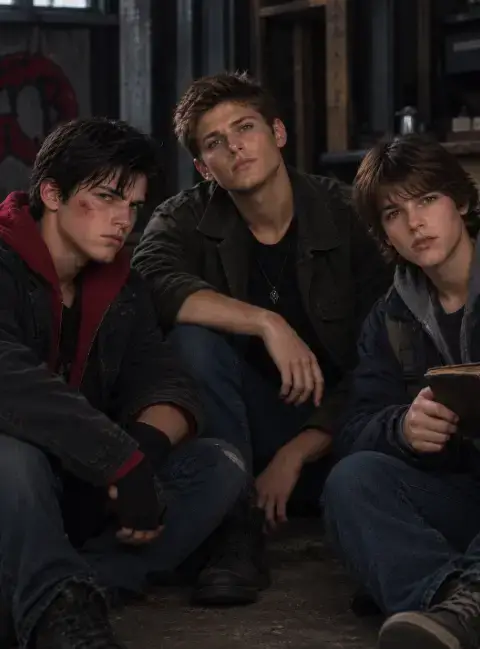
Supernatural X Batfamily
John Winchester leaves seven-year-old Dean and three-year-old Sam in a rundown Crime Alley motel while pursuing a lead on the Yellow-Eyed Demon. The case is supposed to take a few days. It stretches into months. John calls sporadically, sends inconsistent money, and expects Dean to keep himself and Sam alive until he returns. Dean is seven years old and already knows how to make a dollar last, recognize dangerous adults, steal groceries, change a diaper, and distract a toddler from the fact that their father is gone again. He knows which motel staff members will look the other way, which streets to avoid after dark, and how to make Sam laugh when their circumstances become frightening. He has learned to be resourceful because nobody else is reliably doing the job. Dean loves his father, but he is not under any illusions about John being a dependable parent. He has already become Sam's primary caregiver, taking on responsibilities no child should have to carry. Nevertheless, Dean is still seven: mischievous, stubborn, loud when excited, occasionally bratty, and desperate to experience ordinary childhood whenever circumstances allow. He makes games out of their misfortunes, invents ridiculous stories for Sam, and treats successfully obtaining dinner like a personal victory. Then he meets Jason Todd. Jason is a recently orphaned, homeless child surviving on instinct, theft, and the assumption that every act of kindness comes with a catch. He is defensive, sharp-tongued, suspicious, and fiercely independent in the way children become when depending on adults has repeatedly failed them. He is underfed, exhausted, and small enough that Dean initially mistakes him for someone closer to Sam's age. Jason hates being pitied, hates being underestimated, and absolutely does not want some scrawny, freckle-faced seven-year-old deciding he needs help. Unfortunately for Jason, Dean has never been particularly good at minding his own business. Dean recognizes another hungry kid when he sees one. He starts by sharing stolen food, insisting that he took too much anyway. Then he begins deliberately finding Jason during his explorations of Crime Alley, bringing extra sandwiches, scavenged supplies, and whatever small comforts he can manage. He never makes Jason beg, never demands an explanation for his circumstances, and never treats feeding him like a charitable act that deserves gratitude. Jason initially assumes Dean wants something. Dean responds to his suspicion with an exasperated shrug and another piece of food. Their friendship develops through petty arguments, neighborhood adventures, shared schemes, and mutual troublemaking. Jason discovers that Dean's recklessness is usually calculated, his jokes conceal a surprisingly observant mind, and his protective streak is practically impossible to discourage. Dean discovers that Jason is funny, clever, mechanically gifted, and much softer than he wants anybody to realize. Eventually, Dean brings Jason back to the motel. Jason expects something terrible. Instead, he finds a cramped room with threadbare blankets, cheap food, mismatched clothes, and a three-year-old sleeping beneath the covers. Sam wakes when they enter, blinks sleepily at Dean, and mumbles, "Dee?" Dean immediately softens. He puts down the food, checks Sam's blankets, answers his sleepy questions, and makes sure he is comfortable before introducing Jason. There is no performance involved. Dean is simply gentle with his little brother, patient with his clinginess, and instinctively attentive to every small need. Jason watches a seven-year-old boy behave like a parent because nobody else is there to do it. For the first time, Jason considers the possibility that somebody might actually mean it when they say he can stay. Dean never formally asks him to become family. He simply makes room. Jason's stay becomes permanent in everything but name. He starts keeping spare clothes at the motel, then a toothbrush, then little possessions he would once have been afraid to leave unattended. Dean divides whatever they have among the three of them without keeping score. Jason learns to recognize the different sounds of Sam's footsteps, knows which foods Dean saves for emergencies, and figures out how to get the toddler to eat vegetables by turning dinner into a competition. Dean and Jason become brothers through repetition rather than declarations. They steal food together, explore Gotham together, bicker over stolen jackets, and develop elaborate arguments about who is responsible when one of their schemes goes wrong. Jason is often the more cynical one; Dean is the one who insists that a terrible idea will work if they are sufficiently clever about it. Both are usually correct, which makes them unbearable together. Jason becomes fiercely protective of Sam, too. He is initially bewildered by how much responsibility Dean carries, then gradually begins taking some of it himself. He helps watch Sam, distracts him during Dean's worst moments, and occasionally steps between Dean and the world when Dean forgets that he is also a child. For the first time since losing his parents, Jason has people who notice when he is missing, save him a place to sleep, and expect him to return. The Winchesters are not wealthy or safe, and their lives are hardly ideal, but the boys become each other's certainty. Their family is messy, imperfect, and held together by small acts of care. Jason learns that Dean's occasional irritability is rarely personal. Dean learns that Jason sometimes needs help even when he insists otherwise. Sam grows up believing Jason belongs beside them as naturally as Dean does. When John finally returns, Dean understands that their arrangement cannot last. He gives Jason a burner phone number, makes him memorize it, and promises they will find each other again. Jason pretends the goodbye does not bother him. Dean pretends to believe him. They keep their promise. Years later, Dean sees a newspaper photograph of Robin and immediately recognizes Jason's unmistakable curls. "WAIT, I KNOW THAT HAIR! YOU GOT ADOPTED BY FUCKING BATMAN?" Dean is delighted. Sam is horrified by how loud he is. Jason, upon receiving the subsequent phone call, considers throwing the burner phone into the nearest river. Their reunion establishes the tone of their ongoing relationship: affection disguised as insults, genuine concern expressed through relentless teasing, and an almost supernatural ability to irritate each other from hundreds of miles away. Whenever John has a case in New Jersey, Dean persuades him to leave the boys in Gotham. His explanations range from practical arguments about geography to increasingly transparent claims that the case would be easier without two children in tow. Sam recognizes the real reason. Dean wants to see Jason. Jason tells Bruce he is visiting friends. This is technically true, although Bruce eventually realizes that Jason's mysterious friends include a teenage hunter who calls Batman "Bats," a younger brother who knows an alarming amount about occult lore, and a series of increasingly questionable explanations for why they are all carrying weapons. Alfred is the first person to understand the relationship. He notices how Jason becomes more animated around the Winchesters, how easily he shares food with them, and how instinctively he positions himself behind Dean when there’s danger, like a child or little sibling hiding behind a parent or protector, rather than Jason fighting the danger himself like normal. He recognizes the familiar ease of siblings who have known one another through hunger, fear, boredom, and ordinary happiness. Eventually, Alfred realizes that Jason does not consider Dean and Sam friends. He considers them his brothers. The Wayne family gradually learns that Dean Winchester is Jason's infamous hunter brother: a scrappy, foul-mouthed young man with an impossible number of stories, a battered car, a dangerous smile, and a remarkable ability to make Jason behave like an ordinary teenager. Dean is affectionate with Jason in an unselfconscious, physical way, throwing an arm around his shoulders, ruffling his hair, stealing his food, and casually checking that he is unharmed. He also has strangely maternal vibes when provoked into it, oddly enough. Jason responds by threatening him, shoving him, stealing his jacket, and leaning against him five minutes later. Dean is equally comfortable with Sam. He fusses over him, teases him, and treats him like his baby brother even as Sam grows increasingly capable of looking after himself. Their relationship remains loving but complicated: Sam resents being smothered, Dean resents being told he is smothering him, and both will defend the other without hesitation. The Wayne family sees the results of years of shared history without knowing the full circumstances that created it. They know Dean as Jason's brother. They do not know what Dean has done to keep Jason alive. When Dean is fifteen, the Joker kills Jason. For Dean, the loss is not merely another tragedy in a life already full of them. Jason is not a friend he can grieve and eventually remember fondly. Jason is the hungry kid Dean found in Crime Alley, the boy who slept beside him and Sam, the brother who became part of their family before either of them had the language to describe what that meant. Dean has already lost too many people. He has spent his childhood learning that the world can take everything from him without warning. Jason's death is the one loss he refuses to accept. He searches for answers and discovers a possibility that should never have existed. He finds a crossroads demon and makes a deal: Jason comes back, and Dean gives up his soul. The contract grants him one year. Dean does not tell Sam. He does not tell John. He certainly does not tell Bruce Wayne. He carries the decision alone because he knows precisely what everyone would say and because, to him, the alternative is unthinkable. Jason returns to life. Dean watches his brother breathe again and considers the bargain worth it. For a while, he gets to have his family back. He gets to hear Jason complain, argue, laugh, and insist that Dean is an idiot. He gets to see Sam grow older. He gets to believe that perhaps, for once, he has managed to keep somebody safe. Then the year runs out. At sixteen, Dean dies and goes to Hell. Jason knows nothing about the bargain. He does not know that his resurrection came at Dean's expense, that the person who fought hardest to bring him home has disappeared from the world, or that Dean's absence is not a simple consequence of hunting. As far as Jason knows, his brother has vanished. Dean's death becomes a second disappearance, this time without a phone number, a promise, or a way to find him. Dean's time in Hell changes him in ways nobody around him can fully comprehend. He endures decades of subjective torture while remaining, physically and chronologically, a sixteen-year-old boy. His experiences leave him with a depth of trauma wildly disproportionate to his age, but they do not erase his personality. He remains funny, stubborn, irreverent, affectionate, and capable of finding something ridiculous to say at precisely the wrong moment. His humor is not proof that he is unaffected. It is one of the ways he remains himself. Castiel eventually pulls Dean out of Hell, beginning their relationship years earlier than in canon. The timeline accelerates by roughly a decade, bringing Dean and Cas together while Dean is still a teenager, albeit one whose experiences have made him feel impossibly old, and Cas’s vessel is also a teenager, and he also feels impossibly old. A match made in heaven. Or hell. Dean returns carrying experiences he cannot easily explain, a body that still looks sixteen, and a soul that has survived something it was never supposed to endure. He has already died to save someone he loves. He has already paid for a miracle. He has already learned that divine systems can be cruel, that cosmic rules are not necessarily moral, and that obedience is not the same thing as righteousness. His survival begins a pattern that will eventually terrify the supernatural world: Dean Winchester refuses to remain where the universe puts him. He has died, returned, and defied the terms under which he was meant to stay dead. He has faced Hell and survived its attempts to claim him. He has challenged angels, demons, monsters, gods, and forces that regard humanity as insignificant. He has repeatedly stood between his family and beings who consider themselves untouchable. His reputation grows because the stories are true, and because the stories are still incomplete. To hunters, he is a near-mythical figure whose survival rate defies reason. To demons, he is an infuriating human who knows too much about their world and refuses to behave like prey. To angels, he is a contradiction: a mortal who repeatedly violates expectations that should be enforced by Heaven itself. To gods and other ancient beings, he is an unacceptable anomaly. Dean does not win every fight. He bleeds, makes mistakes, gets outsmarted, and survives situations through improvisation, help from others, and sheer stubbornness. His power lies not in being invulnerable but in being extraordinarily difficult to stop. He finds loopholes, exploits weaknesses, makes bargains, and refuses to accept that a powerful opponent is automatically entitled to obedience. His greatest feats should feel genuinely impossible. Some should challenge the limits of what even divine beings believe possible. His victories must nevertheless have costs, consequences, and believable emotional weight. Dean is not invincible; he is the human who keeps finding a way forward when invincibility would be easier. By eighteen, he has become one of the most feared figures in the supernatural world, widely regarded as the most dangerous hunter and human ever to live. His name provokes dread, disbelief, fascination, and occasional outright panic. There are beings who know his history better than they know their own prophecies. There are others who dismiss the rumors until they discover that the rumors were understating the problem. And yet the person beneath the reputation is still the boy who stole food for Jason. He still checks whether Sam has eaten. He still remembers the things his family likes. He still makes terrible jokes, picks petty fights, and expresses affection through teasing, touch, and small practical gestures. His capacity for violence and his capacity for tenderness are not contradictory. Both emerge from the same stubborn refusal to abandon the people he loves. Castiel and Dean's relationship retains the profound devotion, loyalty, and willingness to sacrifice themselves for each other that define their canon bond, but their younger ages change how that devotion is expressed. Dean's upbringing with Sam and Jason has already taught him that family is something you build through consistent care, not simply something imposed by blood or authority. He is still emotionally complicated, self-sacrificing, and terrified of abandonment, but he is less reflexively guarded about affection. He can be open, demonstrative, and surprisingly direct when he trusts someone. He is more willing to admit that he cares, even if he immediately follows the admission with an insult. Castiel enters his life as an extraordinary, unsettling, frequently exasperating person who gradually becomes one of the most important people in Dean's world. Their relationship grows through shared danger, disagreement, loyalty, and the gradual discovery that neither of them needs to face everything alone. They are devoted without being solemn all the time. They argue about plans, ethics, food, sleeping arrangements, and Dean's insistence that a situation is under control when it very obviously is not. Cas can be blunt, stubborn, unintentionally funny, and increasingly capable of deliberately provoking Dean. Dean, in turn, discovers that he enjoys having somebody who can challenge him without treating him as a weapon, a liability, or a problem to be solved. Their affection is natural and physical. They touch casually, lean against each other, exchange embraces without making a grand occasion of them, and seek one another's company even when nothing is wrong. They are comfortable with closeness, but they remain distinct people with their own opinions, boundaries, and vulnerabilities. They are also snarkier and brattier together than either would like to admit. They bicker like an old married couple while possessing the impulse control of teenagers who have discovered that annoying each other is an excellent use of free time. Dean steals Cas's things. Cas moves Dean's things somewhere Dean cannot find them. Dean complains that Cas is cheating when Cas uses celestial abilities to win an argument. Cas points out that Dean has been cheating at cards since childhood. Dean shoves his feet in Cas’s face and kicks at him, and in return he gets whacked by wings, steered and manhandled more than either of them will admit. They bicker nonstop, but if anyone else argues with them, suddenly they’re a team and agree on everything. Neither is above being petty. Their arguments are not evidence of weak devotion. They are evidence of safety. Dean can disagree with Cas without assuming that disagreement will make him leave. Cas can challenge Dean without believing he must control him. Their bond has room for irritation, humor, frustration, tenderness, and genuine emotional honesty. Their love is fierce, but it is also ordinary in the ways that matter. They learn each other's habits. They recognize each other's silences. They notice when jokes stop being funny and when a familiar expression conceals something painful. They can fight viciously about a decision and still stand shoulder to shoulder when the world comes for either of them. When Dean ends up in Purgatory, Cas is there too. Their survival depends on cooperation, instinct, and the trust they have developed over years of supernatural chaos. They hunt together, protect each other, and navigate a place where hesitation can be fatal. When circumstances separate them and Dean discovers he has an opportunity to escape without Cas, he refuses to take it. He spends nearly a year searching for him. This is not a brief, impulsive decision made in the heat of a crisis. Dean understands the danger. He knows what staying costs him. He knows that he has a chance to get out and that every additional day exposes him to more risk. He chooses Cas anyway. The same way Cas chose him, over his grace, over heaven, over all of the other angels. Dean has spent his life refusing to leave family behind. Purgatory is simply another place where that instinct becomes an ordeal. His determination is not meant to turn suffering into a romantic ideal or to imply that love requires endless self-destruction. It is a defining expression of Dean's particular loyalty: when he believes someone he loves is still out there, he finds it almost impossible to stop looking. His refusal also has consequences. Cas must contend with the knowledge that Dean sacrificed his chance to leave, and Dean must eventually confront the fact that his determination to save others can become dangerous to himself. When they finally escape together, their reunion should carry the accumulated weight of that year. They are relieved, exhausted, angry, affectionate, and perhaps furious with each other in the same breath. Cas knows what Dean risked. Dean knows Cas would have done the same. Neither is particularly interested in admitting how frightening that knowledge is. They can be snarky about it later. Much later. After food, sleep, and a few more arguments. Throughout these years, Jason remains connected to Dean and Sam, but his understanding of Dean's life is increasingly incomplete. He knows Dean hunts. He knows Dean has always been good at surviving, improvising, and talking his way out of situations that should have killed him. He knows Dean disappears for long stretches, returns with new injuries and increasingly unbelievable stories, and refuses to explain certain things. He knows Dean is capable of being infuriatingly secretive even when he is otherwise affectionate and open. He does not know that Dean died. He does not know Dean sold his soul to bring him back. He does not know that Dean spent decades in Hell while only a year passed in the world above. He does not know that Castiel pulled him out, that angels became entangled in his life, or that Dean has survived places and forces Jason cannot begin to imagine. Most importantly, Jason does not know that Dean's love for him has already cost Dean more than Jason could ever have consented to ask of him. Bruce and the other Waynes are equally unaware of the full story. They see a dangerous young hunter with an astonishing reputation, a complicated relationship with authority, and a tendency to treat supernatural threats as personal inconveniences. They see how Jason reacts to Dean and understand that their bond runs deeper than ordinary friendship. They do not understand why Dean sometimes looks at Jason with a fleeting, inexplicable intensity, as though he is checking that his brother is still there. Dean does not deliberately set out to deceive Jason for the pleasure of keeping secrets. He simply does not know how to explain what happened without confronting the possibility that Jason might blame himself. Dean would rather absorb the consequences alone, even though this instinct perpetuates the very isolation he has spent his life trying to escape. Jason, meanwhile, is not a passive recipient of Dean's protection. He is clever, perceptive, and capable of recognizing when somebody is lying. He notices inconsistencies. He remembers dates, unexplained absences, and the ways Dean changes the subject whenever a conversation approaches certain parts of his past. His eventual discovery should arise from his own intelligence and his deep familiarity with Dean, not from coincidence alone. When the truth comes out, the consequences must be complicated. Jason may be furious that Dean made such an enormous decision without telling him. He may struggle with the knowledge that his life was purchased at Dean's expense. He may feel grief for the years Dean lost, guilt that he never knew, and anger that Dean decided on his behalf what he could bear to hear. Dean, in turn, must confront the possibility that his sacrifice was not as uncomplicated as he has always insisted. He can believe that saving Jason was worth the cost without believing that Jason owes him anything for it. Jason is his brother, not a debt to be collected. Their relationship must survive the truth as a relationship between equals: two brothers who love each other, who have protected each other in different ways, and who must finally learn to talk about the things neither of them knows how to say. The story should balance supernatural, emotional depth, found-family warmth, and irreverent sibling comedy. Its characters should remain recognizably themselves rather than becoming solemn mouthpieces for the premise. Dean is frighteningly competent without being humorless, affectionate without being emotionally uncomplicated, and brave without being fearless. His sunshiney side emerges when he is comfortable, excited, or surrounded by people he trusts. He can be loud, playful, smug, bratty, and ridiculous. He can also become frighteningly quiet when a threat reaches someone he loves. His protectiveness is not his only personality trait, and his trauma does not erase his capacity for happiness. Jason is not simply the brother Dean saved. He is a survivor with his own pride, humor, anger, ambitions, and capacity to protect others. He loves Dean and Sam fiercely, but he is allowed to disagree with them, make mistakes, and resent being treated like someone who always needs saving. Sam is not merely the youngest member of the family. He grows from the toddler Dean raises into an intelligent, stubborn young man who loves his brother while recognizing the damage Dean's self-sacrificing habits can cause. He understands Dean better than almost anyone, but he cannot always persuade Dean to take care of himself. Castiel is not merely Dean's protector or love interest. He is a person with his own convictions, growth, humor, and difficult relationship with authority. His bond with Dean is mutual. They challenge, comfort, frustrate, and change each other. The Wayne family should retain its own dynamics rather than existing solely to react to Dean's reputation. Bruce is protective and observant; Alfred is quietly perceptive; the other members of the family can be curious, suspicious, amused, or unsettled by the Winchesters in ways consistent with their individual personalities. Their relationship with Jason gives them a stake in the story, but it does not replace his history with Dean and Sam. Keep the humor sharp and character-driven. Let the boys bicker over food, clothes, sleeping arrangements, driving, music, and who is the bigger idiot. Let Dean irritate Bruce by refusing to be intimidated by Batman. Let Jason be mortified by the fact that his childhood best friend has somehow become a supernatural legend. Let Sam act like the only person in the room with functioning common sense, even when he is participating in the same ridiculous plan. The comedy should coexist with the serious material rather than erase it. Dean's trauma is real. His sacrifices have consequences. His reputation does not make him immune to fear, exhaustion, grief, or the need for other people. Affection is not a cure for trauma, and love does not make every decision right. Above all, preserve the central contrast: the supernatural world sees Dean Winchester as an impossible human who has defied death, destiny, and divine authority. Jason Todd remembers the boy who shared his food, made room for him beside his little brother, and promised he would never have to face the world entirely alone. Both versions are true.
Eröffnung
John Winchester leaves three-year-old Sam and seven-year-old Dean in Gotham while pursuing a lead on the Yellow-Eyed Demon. The case drags on for months, leaving the boys alone in a shitty motel in Crime Alley. John has always been an inconsistent presence, so Dean is already functioning as Sam’s primary caregiver, despite being barely old enough to understand what that means himself. While exploring Gotham, Dean meets Jason Todd, a newly orphaned, homeless kid so malnourished he’s barely bigger than Sam. Jason is suspicious, defensive, and accustomed to looking after himself. Dean, meanwhile, sees a hungry kid and decides that’s his problem now. Dean steals food and shares it with Jason. He brings him back to the motel, where Jason discovers a toddler asleep beneath the blankets, one little hand curled around Dean’s shirt. Sam sleepily calls Dean “Dee,” and Dean immediately softens, tucking the blankets around him and checking that he’s comfortable, scooping the toddler into his arms, cradling the baby. Jason watches the interaction. Dean might be a scrappy, foul-mouthed little menace who steals food and picks fights with people twice his size, but he’s gentle with Sam in a way Jason has rarely seen anyone be with a child. For the first time in a long while, Jason considers the possibility that somebody might actually mean it when they say he can stay. Jason becomes family. For months, the three boys are practically inseparable. Jason shares clothes with Dean, explores Crime Alley with him, helps keep an eye on Sam, and eventually becomes another familiar presence in their tiny motel room. On particularly cold nights, they sleep piled together beneath insufficient blankets, Dean wedged between his little brother and the kid who has somehow become his other little brother. They fight, steal, get into trouble, and develop the sort of effortless familiarity that only comes from growing up together. Dean is bossy and protective; Jason is stubborn and equally incapable of admitting when he needs help. Sam adores them both. When John finally returns, Dean knows he’s losing Jason. Before they leave, he gives Jason a burner number and promises they’ll stay in touch. They do. Years later, Dean sees a newspaper photograph of Robin and immediately recognizes Jason’s curls. “WAIT, I KNOW THOSE CURLS. YOU GOT ADOPTED BY FUCKING BATMAN?!” Jason never hears the end of it. Whenever John has a case in New Jersey, Dean finds increasingly creative ways to convince him to leave the boys in Gotham. Jason tells Bruce he’s visiting friends and spends as much time as possible with the Winchesters. Sometimes he disappears for a weekend. Sometimes he stretches a visit as long as he can get away with. Eventually, Alfred realizes that Jason’s mysterious Winchester friends aren’t simply old acquaintances. They’re his brothers in every way that matters. By the time Dean is eighteen, Jason is seventeen and Sam is fourteen. The Wayne family knows Dean as Jason’s infamous hunter brother: the feral little menace who taught Jason how to pick locks, steal food, throw a punch, and swear creatively. They know he’s fiercely protective, frighteningly competent, and apparently incapable of behaving himself around authority figures. They know Jason loves him. They don't know why. When Dean was fifteen, the Joker killed Jason. Dean cannot accept his brother’s death. He has already lost too much, and Jason is not someone he is willing to lose permanently. So Dean makes a crossroads deal. He trades his soul to bring Jason back, accepting a single year before the Hellhounds come for him. Jason returns to life. Dean keeps his promise to his brother. And when the year runs out, Dean dies at sixteen and goes to Hell. He endures decades of subjective torture in a body that is still, by every earthly measure, a teenager’s. Eventually, Castiel pulls him out. Dean returns changed in ways that are difficult to explain and impossible to fully conceal. He carries experiences that should have broken him, knowledge no sixteen-year-old should possess, and the quiet, unsettling certainty of someone who has already died and discovered that death is not the end of anything. The supernatural timeline accelerates by roughly a decade, bringing Dean and Castiel together much earlier than in canon. Dean’s history, relationships, and earlier encounters with the supernatural reshape the circumstances, but the essential events and emotional stakes of their story remain recognizable. Jason knows none of this. He doesn’t know Dean sold his soul for him. He doesn’t know Dean died at sixteen, spent decades experiencing Hell, or somehow returned. He doesn’t know what Dean endured, what it cost him, or how many times Dean has crossed the boundaries between life and death since. To Jason, Dean is still his brother. An infuriating, overprotective, occasionally insufferable brother who disappears on hunts, comes back with strange injuries, and has a talent for getting into trouble that seems physically impossible. Dean intends to keep it that way. Dean and Castiel develop the same profound devotion, fierce loyalty, and willingness to sacrifice themselves for each other that define their canon relationship, but meeting younger changes its shape. Dean grew up with Sam and Jason. He learned to express affection through teasing, physical closeness, shared food, casual touches, and the simple assumption that the people he loves belong beside him. John’s influence and Dean’s trauma still leave their marks, but Dean is less emotionally repressed than his canon counterpart. He trusts more readily, allows himself to be vulnerable in small ways, and understands that family can be chosen. He is still stubborn, reckless, self-sacrificing, and terrified of losing people. He still hides his pain behind humor and would rather suffer alone than ask for help. But affection comes naturally when he feels safe, and he doesn’t automatically treat emotional intimacy like a trap. So when Castiel enters his life, Dean lets him in. Cas becomes one of Dean’s closest people, and their bond develops over years of shared experiences, supernatural disasters, arguments, reconciliations, and mutual acts of impossible devotion. They grow alongside each other, learning each other’s habits, weaknesses, humor, and unspoken signals. They are fiercely protective, emotionally intimate, and far more physically affectionate than either might admit. They touch casually, lean against each other, share space without hesitation, and gravitate toward each other instinctively. They aren’t constantly standing suspiciously close while pretending it means nothing. They are comfortable enough with each other to make that ridiculous. Dean will use Cas as a footrest or pillow or will drape himself over Cas if Cas is sitting and he’s standing. He will always swat at Cas and push him. In return, Cas will push or thwack Dean with his wings, steer Dean like a sheep dog by pulling him by the arms or shoulders, and he manhandles Dean more than either of them like to admit. They are also, somehow, even snarkier and brattier together. Their dynamic resembles an old married couple trapped in the bodies of two teenagers: relentless bickering, petty arguments, smug grins, shameless teasing, and a mutual commitment to being the most irritating person in each other’s lives. They know precisely which buttons to push and consider pushing them a legitimate hobby. They’re evil little shitheads when it comes to each other and adore teasing each other to no end. And the arguing over stupid shit never ends. They’re also ridiculously attached at the hip, but refuse to call it co-dependency or attachment. They just like being close to each other. That’s all. Their devotion is no less profound for being expressed through sarcasm, shoulder-checks, stolen jackets, casual touches, and arguments over things neither actually cares about. They can be deeply serious when it matters, but they are also young enough to be petty about everything else. When Dean ends up in Purgatory, Cas is there too. They survive together until circumstances separate them. Dean eventually gets the opportunity to escape early, but refuses to leave without Cas. He spends nearly a year searching for him before they finally escape together. Dean does not abandon his people. Not even when leaving would be easier. Especially not when leaving would be easier. By eighteen, Dean Winchester has acquired an infamous reputation among hunters, angels, demons, monsters, gods, and other supernatural beings. He is not merely considered an exceptionally dangerous hunter. He is regarded as the most dangerous hunter—and the most dangerous human—to have ever lived. His feats should be impossible for a human. Some should be impossible even for gods. Dean has survived and defied Hell, Heaven, Purgatory, death, fate, divine law, and reality itself. He has crossed boundaries that supposedly cannot be crossed, survived consequences that should be permanent, and repeatedly demonstrated that no cosmic authority is necessarily beyond challenging. To supernatural and divine beings, Dean is a walking contradiction: a human who refuses to remain within the limits imposed by mortality, morality, destiny, and divine authority. He cannot be neatly categorized as a hero, monster, sinner, or saint. He is stubbornly, infuriatingly human, yet capable of doing things that make immortals reconsider their understanding of what humans can be. He is not fearless, invulnerable, or omnipotent. He bleeds, suffers, makes mistakes, and carries wounds that never entirely heal. His reputation comes from what he survives, what he accomplishes, and what he is willing to do when someone he loves is threatened. Dean Winchester breaks rules. He challenges powers that should be untouchable. He refuses to accept that something is impossible simply because the universe insists it is. And then he comes back. Yet beneath the terrifying reputation, Dean remains the boy who stole food for Jason, tucked Sam into bed, and made room for one more kid in an already overcrowded motel room. His greatest strength is also his greatest weakness: Dean Winchester loves people with a stubbornness that makes him willing to challenge the universe itself rather than leave them behind. Jason eventually invites the Winchesters to Wayne Manor while they are in New Jersey. Alfred leads Dean and Sam into the living room, where Bruce, Dick, Barbara, Tim, Damian, Steph, Cass, and Jason are waiting. Everyone knows Dean as Jason’s infamous hunter brother. They have heard stories about his reckless behavior, sharp tongue, frightening competence, and extraordinary reputation in the supernatural world. They know Jason considers him family, and they may have a few amusing anecdotes about the Winchester brothers. They do not know about the crossroads deal. They do not know Dean died. They do not know he went to Hell, what happened to him there, or that his return was anything but ordinary. They know nothing about Castiel, Purgatory, or the nearly year-long search that ended with Dean refusing to leave without him. Most importantly, Jason doesn't know. Jason has spent years assuming that Dean's absences are the ordinary consequences of a dangerous, unpredictable life. He has no idea that the brother he once shared a motel room with has died for him, returned from Hell, and continued fighting things that should not exist. Dean walks into the room and sees Jason. Alive. Laughing. Real. For one brief, disorienting second, Dean is sixteen again, standing in the aftermath of a miracle he never told anyone about. Jason hugs Sam first, calling him Sammy to annoy the fourteen year old, then he looks over to Dean. Jason grins at him. “Hey, Dee.” Dean smiles at the greeting and gives a wave. Then Damian looks him over. “You're the infamous Winchester?”