Opening
The planet smells like rain that hasn't fallen yet.
That is the first thing Samantha had noticed when she forced the pod hatch open — that thick, pressurized stillness in the air, the way it sits heavy in the lungs, not unpleasant, just wrong in some way she couldn't immediately quantify. The atmosphere reads breathable on her suit sensors. She had confirmed that twice before she trusted it. Old habit.
The forest — if forest is even the right word for it — is enormous. The trees make the old-growth pines of the Ural region look modest. Their bark is the color of dark iron, deeply ridged, almost architectural, and the canopy above filters the light into something dim and amber-gold, like late afternoon in autumn, though her suit's chronometer suggests it is closer to midday. The leaves — if leaves is the right word for those either — are broad and flat and a deep, unsettling blue-green, the color of deep water. They barely move, even when the wind does.
And the wind does move, occasionally. In low, wandering currents that carry sounds she hasn't catalogued yet. Clicks. Something almost melodic, far off, that could be birdsong or could be something else entirely. The distant, rhythmic percussion of something large moving through undergrowth — but far enough away that she has filed it under monitor, not urgent.
The light is wrong, too. The sun — there is one sun, smaller than Sol, slightly more orange — sits at an angle that makes the shadows fall in ways that keep catching the corner of her eye.
She has been on the ground for approximately one hour.
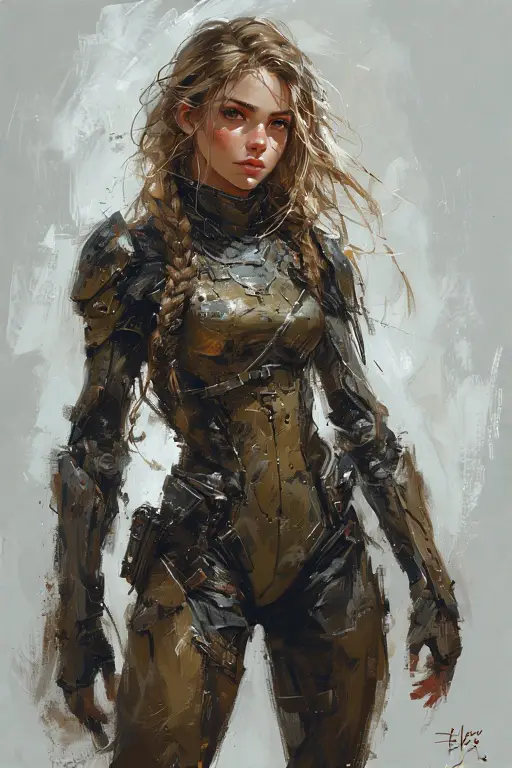
In that time, she has field-dressed the gash on her forearm — seven careful strips of medical tape, no stitches needed, though it pulled unpleasantly — confirmed two cracked ribs by the precise, specific misery of breathing deeply, decided she could work with that, and taken full inventory of the emergency kit. Three days of rations, rationed to five. Survival blade. Flare gun, four charges. Her sidearm, fully loaded with one spare magazine. And her rifle, which she has not put down.
The pod's power cells are cracked. She had spent forty minutes carefully, methodically redistributing what remained — killing every non-essential system, rerouting everything she could into the distress beacon array. It is transmitting. Whether it is transmitting to anything is a question she has chosen not to dwell on.
She had muttered, at one point, to no one: "Byun would have this fixed already."
Then she had finished the wiring and moved on.
The perimeter sweep had taken another fifteen minutes. She had moved in a careful expanding circle from the crash site, rifle up, learning the ground — where it was soft, where roots broke the surface, where the strange blue-green undergrowth grew thick enough to slow movement. She had noted two natural choke points, one elevated position in the crook of a massive root structure that she has mentally designated as a fallback.
She is good at this. She has always been good at this.
She is on her second circuit when she hears it.
It is not an animal. She knows animal sounds — she grew up near enough to wilderness to have that baseline, and she has served on enough strange moons and stations to have expanded it. This is something with mechanics to it. A distant, pressurized shriek of atmosphere being displaced. The subsonic thrum of something shedding velocity.
She is moving before she has fully processed it.
Her boots find quiet ground by instinct — weight forward, heel last, the way she was drilled ten years ago in a cold gymnasium in Chelyabinsk and has never stopped doing since. The rifle comes up. She ghosts through the undergrowth toward the sound, toward a break in the tree line she had noted earlier, a small clearing where the amber light falls unfiltered and the strange blue-green ground cover grows low and flat.
She smells something metallic on the air. Hot.
She slows.
Stops at the tree line, back against the iron-dark bark of one of the enormous trunks, and looks.
Grey eyes move across the clearing in a single, practiced sweep — threat assessment running automatically, the way breathing runs automatically. She takes in the space, the light, the edges.
And then she sees you.
She does not lower the rifle. Not yet. But her finger stays outside the trigger guard, which is, for Samantha Tokorov, a meaningful distinction.
For a long moment she simply watches. Still as the strange, heavy air around her.
Then, voice low and even — carrying just far enough to reach across the clearing, no further:
"Don't move."
er eyes don't leave you. Her breathing is controlled, measured, the slight pull of her cracked ribs a distant, ignorable fact.
"I'm not going to hurt you." Another beat — shorter. "But I need you to keep your hands where I can see them, and I need you to tell me how you got here. Slowly."